Monday, January 16, 2017

On MLK: Diversity in Craft Beer

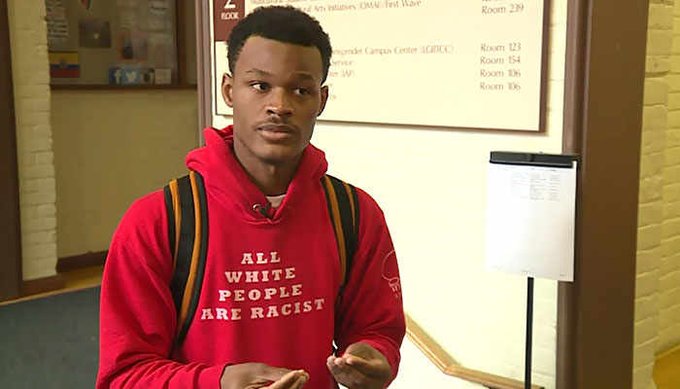
I'm a white guy (see picture over there to the right). It's somewhat awkward for me to talk with any authority about race and gender. I'm a thoroughly modern male; I have a number of black and female friends. I support the Black Lives Matter movement and I've been involved and outspoken at times regarding poverty and race issues in Madison. All of this is to say that I don't think I'm a racist, sweatshirt slogans notwithstanding.

 Somewhere out in the interverse is some video of me talking about race and craft beer. I've spent a lot of time at craft beer festivals; I've been involved in the craft beer industry for over a decade. It's sad to say, but I could probably count the number of african-americans specifically, but non-whites in general, that I've run into on a small number of fingers and toes. It is a predominantly white industry; an uncomfortably white industry. Do I think it's an intentional practice of exclusion? Of course not. But unintentional racial effects are racial effects nonetheless.

So, I was glad to see Chauncey Jackson take up the discussion.

Dr. King was–and the living idea of him is–as close as we have ever come to the human embodiment of equality and inclusion in America. Unfortunately, when it comes to craft beer, those two concepts are pretty foreign. And that doesn’t just apply to black people, but women as well. Although, in recent years, we have seen a significant increase in the amount of women participating in both the industry and craft beer community alike. But, as you likely can see for yourself, those same strides of diversity haven’t crossed over into how the beer scene interacts with black Americans.

This article is a wraparound to Mr Jackson's video. You should watch it and think about the issues he raises.

Wednesday, January 11, 2017

Madworks and SlowMoney and Food and Beverage

First, the important stuff. If you are a food and beverage startup, Madworks Accelerator's spring cohort will be dedicated to food and beverage. YOU SHOULD APPLY. This Spring cohort is in conjunction with Slow Money Wisconsin; the companies participating in MadWorks will also be invited to pitch at the Slow Money Wisconsin Investor Showcase.

OK; with that out of the way, what's going on here?

I have been peripherally involved in both Madworks and Slow Money for the last ... ummm ... I don't really know to be honest. We'll call it the last "few" years. Both are wonderful programs.

Madworks is a seed accelerator dedicated to nascent entrepreneurship. It has changed focus over time with the changing demands of the Madison entrepreneurial community. At first, it was dedicated to true, brand new, nascent entrepreneurship. Today, it focuses a little further upstream helping companies already in the "pipeline" so-to-speak to better understand nuanced governance issues that are demanded of young CEOs with small teams and limited budgets. In other words, these teams don't yet have a staff CFO to generate financial statements; they don't have a general counsel to call shareholder meetings and record board minutes; they don't have sophisticated brand managers to think strategically about marketing plans. So, Madworks helps to get them up to speed - getting them to at least speak the language and understand the obligations that their companies will need to undertake.

Slow Money Wisconsin is a regional network of the national Slow Money organization. It is a non-profit comprising investors throughout Wisconsin that are "dedicated to catalyzing the flow of capital to local food systems, connecting investors to the places where they live and promoting new principles fiduciary responsibility that "bring money back down to earth." In other words, not every business is unicorn. Indeed, to be a responsible corporate citizen you probably shouldn't be a unicorn. By definition, not every company can be a unicorn. More importantly: not only is it probably bad company policy to want to be one, it is better for society and the environment if you aren't.

In startup ecosystems, not aiming to be a unicorn is heresy. Most cogs in the startup ecosystem machine are built on the fundamental premise of delivering the unicorn to investors. I understand that; I'm OK with that. But, hear me out. Unicorns require growth - and not just steady you're-doing-great profitable growth, but crazy, if-you're-profitable-you're-doing-it-wrong growth. In other words, if you are going to be a unicorn, you are, by definition, losing (a lot of) money.

On the other hand, it's possible to take time and grow a company organically - to design a business model that is cash flow positive relatively early on. You can build a company that not just hires people, but makes a point of hiring diversely from your own community thus building capacity in the local employee base. Interestingly, local hiring also has the effect of keeping the money the company makes in the local economy, thus it builds sustainable economies. Agricultural companies can (and should) use regenerative (or at least sustainable) agricultural practices. The effect of building businesses in a fundamentally sustainable way, though, is to depress profitability at the expense of corporate, economic, and environmental stability. Slow Money recognizes that these companies are as important, if not more important, than the unicorns. Investors in Slow Money want to put their money into companies that build stronger systems for overall economic wealth, not just seek to exploit those systems to build shareholder wealth.

So, Slow Money and Madworks are teaming up for a cohort of food and beverage companies. It'll be a wonderful partnership and I can't wait to work with this next class!

Monday, January 9, 2017

Freedom of Information

Kregos v. Associated Press, 937 F.2d 700 (2nd Cir. 1991)(cert. denied)

The fundamental copyright principle that only the expression of an idea and not the idea itself is protectable, see Mazer v. Stein (1954), has produced a corollary maxim that even expression is not protected in those instances where there is only one or so few ways of expressing an idea that protection of the expression would effectively accord protection to the idea itself. Our Circuit has considered this so-called “merger” doctrine in determining whether actionable infringement has occurred, rather than whether a copyright is valid, see Durham Industries, Inc. v. Tomy Corp. (2d Cir. 1980), an approach the Nimmer treatise regards as the “better view.” See NIMMER ON COPYRIGHT § 13.03[B][3] (1990). Assessing merger in the context of alleged infringement will normally provide a more detailed and realistic basis for evaluating the claim that protection of expression would inevitably accord protection to an idea.


To be sure, we can (and do, for good reason) grant creators of information certain rights; we can even allow these rights to be sliced, diced, poked, prodded, traded, rented, and sold; but we haven’t converted the intangible into the tangible. At the end of the day there remains something fundamentally different between Blackacre and a Britney Spears album.
...
While the holy grail of perfect DRM is plainly a major goal of at least some in the copyright industries, I deal in this section with reality. And there are very good reasons to doubt the meaningful impact of DRM anytime soon. 
 

There are cases where using nonfree software puts pressure directly on others to do likewise. Skype is a clear example: when one person uses the nonfree Skype client software, it requires another person to use that software too—thus both surrender their freedom. (Google Hangouts have the same problem.) It is wrong even to suggest using such programs. We should refuse to use them even briefly, even on someone else's computer.

Those with access to these resources — students, librarians, scientists — you have been given a privilege. You get to feed at this banquet of knowledge while the rest of the world is locked out. But you need not — indeed, morally, you cannot — keep this privilege for yourselves. You have a duty to share it with the world. And you have: trading passwords with colleagues, filling download requests for friends.

Ideas almost never remain static on the Web. They are launched like children into the world, where they are altered by the many different environments they pass through, almost never coming home in the same form in which they left.
...
Although many would balk at defining themselves this way, the digital young are revolutionaries. Unlike the clucking boomers, they are not talking revolution; they're making one. This is a culture best judged by what it does, not what it says.

Thursday, December 29, 2016

Innovation in Food and Beverage is Expensive

Here's some "leaked" documents in ReCode about a food delivery startup called "Maple". The basic gist of the company is that instead of going to a restaurant, the restaurant comes to you (ahem: delivery). Uber has tried a delivery service that doesn't seem to be going anywhere fast. EatStreet is testing delivery because, well, a menu aggregation site only gets you so far. I could do this all day; the point is, the list of failed or failing restaurant/delivery services goes on and on.

Why?

Delivery is expensive. Duh. Add that to a meal that already has a relatively low margins, and a $10 meal becomes a $15 meal really fast. OK; still, $15 isn't bad, but for $5 I'm willing to bet most of us will either forego the $10 meal or, more likely, just run for some takeout ourselves and pocket the $5.

And, here's the thing that a lot of people forget: restaurant food is pretty expensive. It's made (and served) by people who are expensive, uses ingredients that are either modestly expensive or grotesquely bad for you and/or the environment, and goes "bad" quickly (not, as in "goes bad it will kill you" like with spoiled or contaminated food, but as in "goes bad and you will complain it's too cold and/or soggy" or whatever).

[ed note: I'd normally provide evidence for each of things I've claimed above. I feel that doing so would detract from a relatively concise point I'm trying to make, so I will leave it to you to go find evidence (dis)proving the things I've claimed if you care to]

People underestimate the impact of labor costs in the food that they order out. In particular, they forget that the price of the food at a restaurant only includes $2+/hr for wages for the server (and then you tip). There is lots of evidence to show that tipping is a terrible way to pay people, but the business effect is that it makes it seem like food is a lot cheaper than it actually is.

Here's a thought experiment: pretend there is a restaurant with tipped staff where a burger is $10 and you pay $2 in tips; and right next door is a restaurant of exactly equivalent quality where the burger is $12 but there is no tip. Which would you go to.

Here's a really interesting report from the USDA. Its conclusion is: "... that the demands for disaggregated FAFH [ed note: Foods Away From Home] products differ in price responsiveness and tend to be more sensitive to changes in food spending patterns than FAH [ed note: Foods at Home] products."

In normal-people speak? You're going to buy the $10 burger.

These delivery services are trying to take what the USDA calls a "premium" FAFH and "turn it into" a FAH. But, here's the rub: we seem to treat the pricing as if it's still a FAFH product. The price of delivery creates a price discrepancy between competing FAFH experiences and the USDA report says that instead of paying the premium for delivery, we're more likely to either substitute with FAH products or prefer the less-expensive (i.e., carry-out) FAFH option.

For businesses that want to "innovate" in this space this means that you (your business) needs to cut into ingrained consumer practices and attitudes. Normally this is done through costly consumer education (read: "marketing") campaigns to convince the user that your product is worth the premium. Good luck!

Wednesday, December 21, 2016

The Change I'd Like to See in the Entrepreneurial Community

This is a question I've been thinking about a lot lately. What is "entrepreneurship"? It has a lot of meanings.

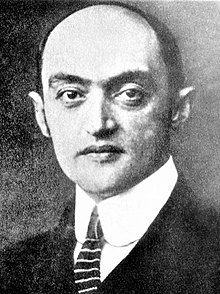
We could get old-skool and talk about Schumpeter. A Schumpeter-ian entrepreneur is someone who is an "innovator" who "exploit[s] market opportunity through technical and/or organizational innovation." [cite] This is certainly the prevailing modern definition as well. When we hear about entrepreneurial hubs, entrepreneurial ecosystems, and supporting entrepreneurship in the university setting, this is almost inevitably the image that is being evoked.

We also have the Knight-ian entrepreneur. Frank Knight, also a Chicago Economist (technically Schumpeter was not a Chicago economist - but there is a lot of cross-over between the Chicago school and the Austrian economics of Schumpeter, Mises, and Kirzner), argued that an entrepreneur is a "risk-taker." In particular, the entrepreneur is the individual that takes risk, as opposed to an employee who doesn't accept the risk of failure or success but receives instead a salary irregardless [ed note: I've been made aware the "irregardless" is not a proper form of speech, however, I fall in the line of thinking that words have meaning in context and since "irregardless" clearly has a meaning - everyone knows what it means even if artfully spoken - I will keep it here in honor of Finnegan's Wake] of the success of their work. This, too, is a popular model of entrepreneurship; we don't normally think of Knight's risk-taker as being mutually exclusive of Schumpeter's innovator.

And, just for the sake of (neo)Classical Economics completion, we have a third economic model of entrepreneurship from Israel Kirzner (also an Austrian economist). Kirzner views entrepreneurship as arbitrage filling a market gap for profit opportunity until competition can negate the market premium captured by the entrepreneur.

Keynes, for his part, took a more basic approach to entrepreneurship. Keynes called the "owner of the production factor" the "entrepreneur." This is a bit similar to Knight's entrepreneur except Keynes doesn't bother to ask why this particular person happens to command the means of production.

All of this is background for the trigger that got me re-thinking about what we mean by entrepreneurship at all. I was interviewed by Fine Point Consulting for their Leaders and Influencers blog. At the end of the interview I was asked what change I would like to see in the entrepreneurial ecosystem.

This got me thinking about two things: first, a conversation I had with Madison College about their entrepreneurship support; and second, our work at the Law & Entrepreneurship Clinic. I thought about the kinds of people that go to Madison College, a local community technical college; and I thought about the kinds of people that we work with here at the L&E Clinic.

We fold under our umbrella of "entrepreneurship" all sorts of endeavors that have little to do with innovation, risk-taking (although here I mean "risk" in the more colloquial sense, not the strictly economics or legal sense that Knight would use), or taking advantage of market opportunities. For Madison College, and for many of our clients, entrepreneurship is more closely related to Keynes' matter-of-fact definition - the owner of the factors of production - and little more. A person has a skill and another person wishes to hire that person to perform that skill. Even this single person (who we often call a "consultant" or "independent contractor"), who in days of old would have been Knight's "employee" are now finding themselves, whether they want to be or not, as entrepreneurs.

Here, I'll point to Tim Syth's interview with Janice Simmons of Accenture. The "gig economy" is making entrepreneurs of employees. Knight's mutually exclusive distinction between the entrepreneurs and the employees is rapidly eroding in a post-bubble universe. Although interestingly, these post-recession changes are in fact all about the shifting of risk.

So, when I was asked about the change I'd like to see in the entrepreneurial community, I said: "I think we need to have a broader discussion about what is and isn’t entrepreneurship." And by that, I meant this: a lot of our policy and incentives and ecosystem is built around the Schumpeterian view of entrepreneurship. Yet, increasingly, more and more of our clients follow in the mold of the Knightian or simply the Keynesian entrepreneur. I'm not convinced that the same incentives and support systems work for both. So, as we think about how to improve our ecosystem, maybe we should start thinking about to support and incentivize different kinds of entrepreneurship other than simply innovation-based.

Monday, September 14, 2015

Smart Contracts are a Future

People like to say "such and such is the future of the law." I happen to believe that "the law" is not "a thing." There are numerous laws - just ask a Public Defender to write an Operating Agreeement, or a patent lawyer to write a will, you'll see what I mean.

It's a cliche to say, but technology is changing the practice of law. For you senior partners, just recall the integration of computers into the workplace. For you managing and active partners, you'll recall the introduction of online research. For senior associates think abou the social media revolution and how that has changed not only marketing, but client communication. For new associates, well, you don't get paid to think - just finish your assignment and get that brief to Janet.

Technology is already playing a role in access to legal services. Skype enables access to lawyers for clients in rural areas. Services like UpCounsel can find you an expert anywhere in the country. It is also playing a role in the performance of legal services - from online research to cloud-based practice and document management. Every courtroom is now equipped with multiple computers for everything from docket management to displaying evidence.

So far, though, technology has largely been used to bring lawyering into the 21st century. Being a lawyer today from a practice perspective is still functionally identical to being a lawyer in the 90's, 80's, 70's, 60's, 50's, 40's, 30's, 20's, etc. etc. The practice of law itself has not been fundamentally changed by technology in the way that, say, advanced manufacturing has completely restructed production of goods. People who cut dies are no longer high school dropouts - they are college-trained computer and manufacturing engineers programming advanced robotics. Not to mention cloud-storage being the "killer app" to tree-based document production.

Smart contracts are going to start the re-invention of the practice of law in the same way that robotics has redefined manufacturing. It won't be better or worse, but it will be different - and it will require very different skills.

What is a "smart contract"? A smart contract is a set of "computer protocols that facilitate, verify, or enforce the negotiation or performance of a contract." It is not only a contract that is self-enabling, but it is self-enforcing. We already deal with some smart contracts in our every day lives - think about iTunes and the music you "purchase" from iTunes. As you are aware, that "purchase" is not a "purchase" at all, but a license from Apple to use a music file that contains a bit of music on it; you may use it subject to some terms - for example, you can only download and play it on up to 5-7 Apple devices. There is a bit of code embedded into every music file that checks how many different devices it has been downloaded to and whether those devices are Apple devices - if either test fails, you can't play your music. That license is self-enforcing - it doesn't need a lawyer at your house to audit where you download it and what kind of devices you play your music on.

In one of the earliest papers on smart contracts (1997), Nick Szabo (himself an enigma wrapped in a puzzle) describes another such smart contract: A car loan. In his hypothetical, he describes the contract as such: a consumer gets a car loan that requires repayment for a term and is secured by the car. At the time of the loan a lock is installed on the car and lock is programmed to do the following: 1) let in the owner but exclude third parties; 2) a second opening option for the creditor; 3) the creditor option is only turned on if the borrower fails to pay for some period of time; 4) upon final payment of the loan, the creditor option is disabled. Again, we have a self-enabling and self-enforcing contract. While it would require sophisticated electronics (verified that it only does what it says it will do and cannot be hacked), it requires nothing more than the technology to enforce the contract.

The parenthetical caveat to that hypothetical, while an aside, is probably the most important part of the sentence. Without security (technological, not legal security) to prevent hacking the contract cannot be self-enforcing. Without technology to truly and unmistakably verify the participants and the payments, the contract cannot be trusted. While it would be hubris to suggest that those problems are "solved" (they aren't), it would certainly be true to suggest that they are very close to being solved.

Without getting into too much detail, the technology that underlies Bitcoin (itself, possibly, maybe, invented by Szabo), called the blockchain, might form the basis for solving the verification and security of smart contracts. New technologies, like Ethereum, are making this a reality. Originally, this was going to be the whole centerpiece of this article. But, I see I'm running long, so I'll cut it short here and just say that I'll describe how Ethereum works and its potential applications in a later post.